 Previous
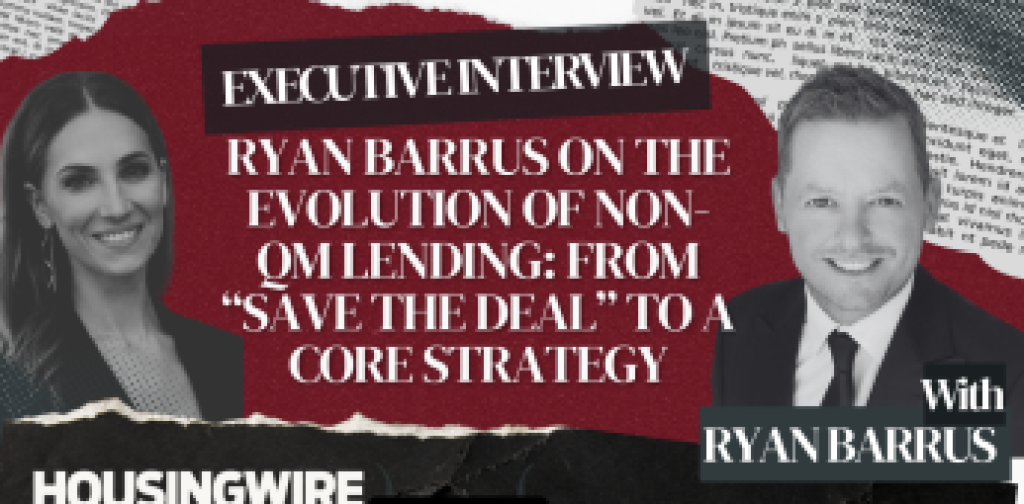
 In this conversation with HousingWire’s Allison LaForgia, Ryan Barrus, National Director of Sales at Acra Lending, reflected on the transformation of the non-QM lending market, the importance of trust-based broker relationships and why loan officers who think proactively are finding success with today’s increasingly complex borrowers.
Barrus began by sharing his path into the industry and the lessons that shaped his leadership philosophy. “When I started, it was a much different landscape. Non-QM had not been really well established. Most people hadn’t heard of it. There were a lot of skeptics,” he said.
He credited mentors who taught him that leadership starts with earning trust. “They gave me the guidance of, ‘you really need to lead from the front and establish a followship’. Nobody’s going to follow you if you’re not doing things that are enviable or noteworthy.”
After speaking with thousands of loan officers over the years, Barrus said one theme consistently stood out. “The recurring theme that I always got from them is trust. They need to trust their lender. It’s not so much about rate or program. It’s ‘Can I trust you?’ This is an important relationship with my realtor partner.”
That trust became the foundation of how he approaches customer service and growth. “We live and die by our broker relationships,” Barrus said. “I’ve always really focused on fostering an environment that builds trust between our folks and just looking at how can we get our customers to trust us with more and more of their business.”
Discussing the evolution of non-QM lending, Barrus acknowledged that the industry once viewed it primarily as a last-resort option. “Ten or 12 years ago, it was literally that,” he said. “Before they originated non-QM, it was just saving their agency fallout.”
Today, however, he believes that mindset is outdated. “If, let’s say, two out of every 10 deals that come across your desk are non-QM, you may not need to be the expert in non-QM, but you need to have a good working knowledge of what’s out there.”
He also emphasized that non-QM demand is no longer tied to rate cycles. “Non-QM is available in all interest rate environments,” Barrus said. “That non-QM business keeps growing despite the interest rate environment. And that’s a really great, consistent deal base for our loan officers.”
When asked what separates successful brokers from those who struggle with complex borrowers, Barrus pointed to proactive planning. “The best loan officers look at those tax returns and go, ‘Your CPA did a great job, but you did not show nearly enough income for the house you want to buy.’ And they already know that there are options.”
He recalled a recent borrower with numerous businesses whose tax returns were unlikely to qualify for approval. “The loan officer recognized on day one that these tax returns are not going to work and [instead] got the bank statements and got them uploaded,” he said. “I think that deal closed in like three weeks.”
His advice is straightforward: “Really being proactive in the non-QM origination from the first moment you speak to that client will really dictate your ultimate success.”
Barrus also encouraged mortgage professionals to focus less on rates and more on solutions. “Most of our most successful broker partners are not selling a rate, they’re selling a solution,” he said. “The rate doesn’t matter if you don’t get the deal done.”
That means understanding the borrower’s complete financial picture. “Getting a full picture of what the borrower wants from the jump,” he said. “Go beyond tax returns. What do you have in assets? What do your bank statements look like? How much do you cash flow?”
He shared an example of a borrower purchasing a condotel whose tax returns created underwriting challenges. “But it turns out this borrower had like $3 million in a brokerage account. That’s all we needed,” Barrus said. “The client was thrilled.”
He also challenged the perception that non-QM loans always carry significantly higher rates. “Just because it’s alternate doesn’t necessarily mean it’s a higher rate,” he said. “Solutions can be had.”
Looking ahead, Barrus sees continued expansion for the non-QM market and believes technology will play a major role. “The entire non-QM space is going to keep growing,” he said. “You will see AI involved in underwriting and appraisal review times. And I am really excited for what that will do for turn times.”
For brokers hoping to stay ahead of the market, his recommendation was simple: lean into partnerships. “Really leveraging your relationship with your account executive to drive your business to be that one-stop shop,” Barrus said. “Get with your account executive and understand that they really want to help you grow in every possible way, because the non-QM market just keeps getting bigger and bigger.”