9 minute read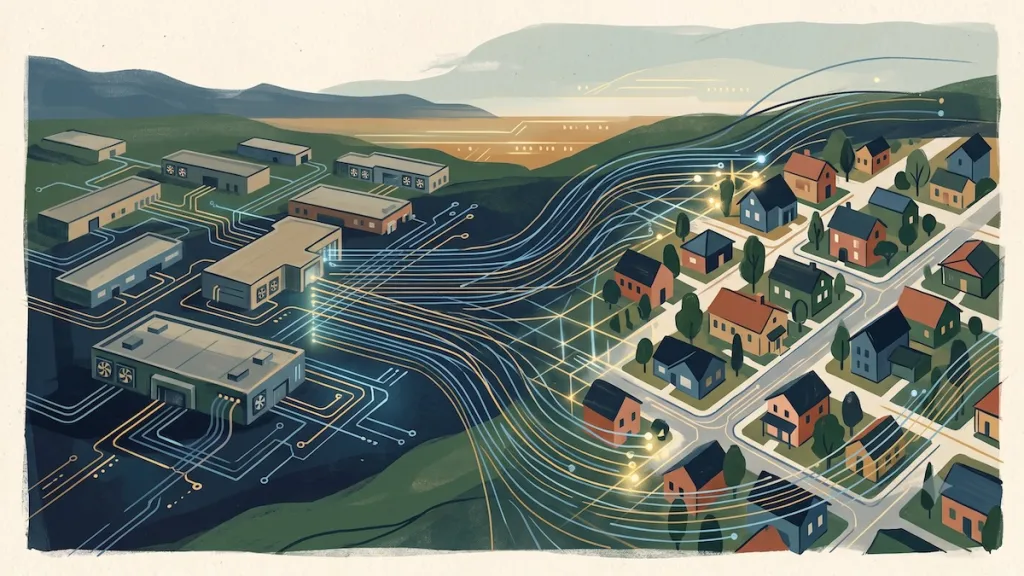
This is part 1 of a 3-part HousingWire special series on the impacts of data centers on housing.
Data centers are creating a split-screen effect in housing markets: They can boost regional demand and land values, while homes near controversial sites may face buyer resistance over noise, water use, construction activity and long-term uncertainty.
That tension is creating a new challenge for real estate professionals, who must assess how data center development could raise regional home values while potentially reducing demand — and prices — for properties closest to the sites.
The sometimes massive facilities generally house computer servers, storage systems and networking equipment that support websites, cloud computing and artificial intelligence. For sellers near proposed or operating data centers, the challenge may be overcoming buyer concerns about noise, water use and future land use.
For buyers, the question is whether they are purchasing ahead of an economic boom — or too close to a project that could make resale harder.
Jerry Allen — a Realtor with eXp Realty and member of the Granbury, Texas, planning and zoning commission — told HousingWire the impact of data centers are becoming increasingly evident in his market, with nearby homeowners facing significant challenges. “The people that live next to [proposed data center and other local industrial sites] are obviously not very happy about it, and they’re having a hard time [selling] their property,” he said.
Bernadine Anderson, a real estate agent and licensed appraiser working near the same area as Allen, agrees that the impact is already being felt. “There [are] million-dollar homes on two acres that are right next to some proposed data centers,” she said. “They’re trying to sell as fast as they can, but the problem is they’re not able to sell because of the data center issue.”
Building pipeline is striking
The U.S. has thousands of operating data centers, with industry databases putting the count anywhere from roughly 2,000 operating facilities to more than 4,500 listed sites, depending on methodology.
The pipeline is even more striking: Aterio, which provides data on U.S. developments, tracks 774 under-construction and 3,724 announced U.S. data centers, while Pew’s analysis of Data Center Map data found more than 1,500 new data centers in development nationally, with most planned projects shifting into rural areas.
The states to watch are Texas, Virginia, Georgia, Pennsylvania, Ohio, Utah, Illinois, Arizona, Indiana and Nevada — not just because of current inventory, but because the proposed pipeline is enormous.
Data from CBRE shows vacancy rates in primary data center markets shrinking to 1.4% in the second half of last year.
Researchers said scarce available inventory continues to limit large-scale projects — prompting pre-leasing and off-market activity.
Allen said the sheer number of proposed facilities is alarming residents, as well as potential buyers looking to move to the area. Anderson said that multiple data centers are planned within a relatively small radius in the area, adding to the uncertainty. “Somebody said nine, but I’ve only heard about four or five,” she said. “They’re all within five miles of each other, and it’s all rural, because that’s where you have all the land. Everybody’s wondering, ‘Why all of a sudden? Why so many? Why do we need them right next to each other?’”
Effect on property values
According to Allen, the arrival of data centers is skewing the entire appraisal process. A data center developer may pay a significant premium for a large tract of land, creating an outlier in the market.
“Do you value [the home] up because the data center is there, or do you value it down because the data center is there?” Allen said. “So, we’re in a state of flux.” Granbury has seen home prices fall 8.2% to $380,000 over the past year, with more than 50% of listings taking price cuts, HousingWire Data shows. However, it’s unclear whether this drop is caused by data centers or is more about current market forces.
On the flip side, Anderson noted that the financial incentives for landowners can be staggering — describing one case where a data center company offered an extraordinary price to reluctant sellers. “They got $360,000 an acre,” Anderson said. “They were older, in their 90s, and they took it. Acreage in that area was normally going for about $25,000. They’re offering ungodly amounts of money for this land.”
Allen shared an example of a friend who was offered a contract for his land near a data center development. The premium offered was hard to believe. “The cash price to buy the place was like $16 million for this tract,” he said. “It probably would have been around $3 million if not for the data center. We’re talking a major difference in money.”
The buyer also paid half a million dollars annually for a four-year option on the property — just to keep the land off the market, according to Allen.
“That part is really screwing us up on real estate, because it’s skewing the appraisal values on land,” he said. “The appraisal industry hasn’t really caught up with that yet.”
Studies measuring the effect on property values have brought back mixed results.
University of Rochester research found data center development has little measurable effect on nearby home prices — while a separate George Mason University-led study found new data centers slowed local home-price growth.
Fears unfounded, so far
While data center developments in Texas have sparked fears of plummeting property values and mass seller exodus, one Ohio Realtor says the impact in her market is more nuanced — rooted in resident distrust rather than immediate sales disruption.
Donna Deaton, a real estate agent with REMAX Victory + Affiliates in the greater Cincinnati area, said she has not seen clients abandon home purchases due to a planned data center.
Over the past year, HousingWire Data shows the Cincinnati-Middletown market holding strong — with median list prices rebounding to $399,000. Trenton currently sits at $282,500.
“So far, no one has said, ‘Oh, I’m not going to move there because they’re getting a data center,'” she said. Instead, Deaton says the most vocal concerns come from existing residents in the area, particularly in Trenton, where a significant data center project is planned.
Deaton also said many residents felt blindsided by the project, though she suggested a lack of local engagement may have contributed.
“The construction is a little bit of a concern, but they’re building it in an industrial area. It’s land that’s already zoned for industrial, so it’s not like they’re going into the neighborhood to build it. Now, is it close to homes? Yes, because [Trenton] is a smaller area.”
Deaton acknowledged the possibility of land-price escalation similar to what Allen and Anderson reported in Texas.
“I have not heard that yet, but I wouldn’t be surprised,” she said. “The further out we go, we’re almost locked in with our area for farmland. We don’t have a whole lot of it left. You have to go out to the more farmland counties.”
Room for optimism?
While data center developments have sparked anxiety in some markets, one Florida real estate team leader views the industry’s growing interest in Polk County as a positive signal for the region’s economic future.
Jen Lay — team leader of eXp Realty-affiliated The Lay Group in Lakeland — said she sees the proposed data center projects as part of a broader economic transformation. “Real estate has always been about the job growth,” she said. “One large employer comes in, then they create demand and then that brings more people to the area.”
Lay said she has not yet had a buyer decline a home purchase due to data center concerns.”I haven’t had any buyer go, ‘No, I don’t want to live there because of a data center,'” she said. “But I’m sure it’ll come.”
Lakeland sits in a highly contested region for data centers due to its strategic position between Tampa and Orlando. While some established data center facilities operate in the area, a massive proposed development named “Project Swan” recently sparked intense debate and a proposed one-year development moratorium.
Lay acknowledged that water and infrastructure are legitimate concerns.
“Water is a big problem in Polk County,” she said. “If they can do [these projects] responsibly, then I believe it’s going to strengthen the housing demand over the next decade. I don’t think one project alone is going to change home values overnight. Real estate responds to sustainability — job growth, wage growth and population growth. We literally just had Orlando Health open their hospital two weeks ago in Lakeland. We don’t know what the impacts of that are going to be yet.”
HousingWire data supports Lay’s assessment. Lakeland-Winter Haven, Florida, remains a relatively balanced market — with prices hovering near $350,000 and little momentum in either direction over the past 12 months.
“This [data center] project has the potential to contribute to those trends, but it’s just one tiny piece of, in my opinion, a larger economic future.”
For real estate professionals navigating client concerns about data centers, Lay recommends encouraging civic engagement. “What I love is that we do have the option to hold our city leaders accountable,” she said. “Are the residents asking the right questions about how they’re tapping into the aquifer, and how we’ll get water? I don’t know, but they need to ask.”
Broader economic impact
While community backlash against data centers has dominated headlines, the economic impact on local housing markets follows a predictable pattern that real estate agents can navigate, according to Selma Hepp, chief economist at Cotality.
“The impact has been something similar to what we’ve experienced, sort of like energy booms, or where there’s an energy town that experiences a demand shock,” Hepp said. “They don’t necessarily have the housing infrastructure, so the influx of the workers and the sheer number of workers is what makes the impact so great on these markets.”
Data centers often require hundreds or even thousands of construction workers during the building phase — creating intense short-term demand for housing.
“The wages of these employees tend to be a little bit higher — engineering facilities, electrical positions that are higher paying — so they have more income to work with, and that adds to the pressure on rents,” Hepp said.
The pattern is consistent; rents increase first, followed by home prices if the economic impact proves lasting, she added.
Hepp pointed to Reno, Nevada, as an example where data center development has created more permanent housing demand. Abilene, Texas, was also cited, where Hepp said data center construction contributed to rents going up 33% year-over-year.
In northern Virginia’s “data center alley,” developers are competing directly with new housing construction for available land, putting significant pressure on the cost of land, Hepp added.
Still, she has not seen consistent research showing negative impacts on home prices from data centers. “If [a homebuyer] is not in the midst of this volatility that’s happening during the construction, if you come in before, you’re more likely to benefit from it,” she said. “That’s because prices are likely to go up. If you’re on the back end, the prices have already gone up, so they’re likely to stay where they are.”
Data centers are creating a real estate tale of two neighborhoods; one seller may face buyer concerns about noise, traffic, utility costs and disruption, while another watches land values climb or rents rise as investment pours in.
A nearby homeowner could see challenges at resale, while a landowner may receive multimillion-dollar offers.
For agents, these projects are becoming a new map marker — a local factor that can reshape demand, pricing and the future of surrounding communities.