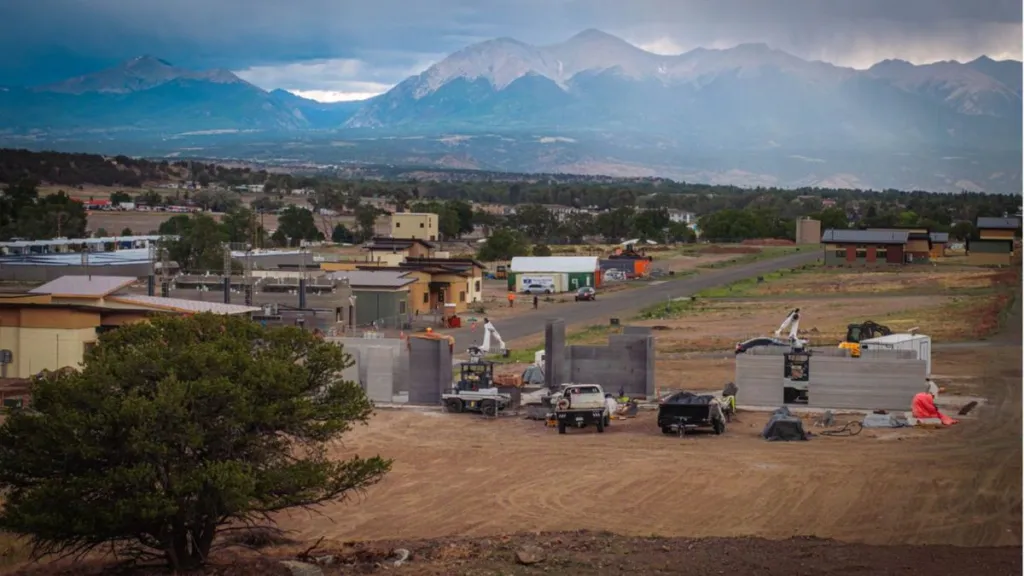
In Salida, a small town in Central Colorado with about 6,000 residents, a long-vacant property serves as a reminder of the community’s past while offering a glimpse into the future.
Cleora, a small railroad town established in 1880 in what is now the Salida area, served as an early settlement in the region. The town declined quickly after its founding and was officially abandoned in 1882 after its post office closed. For more than 150 years, the historic site remained vacant.
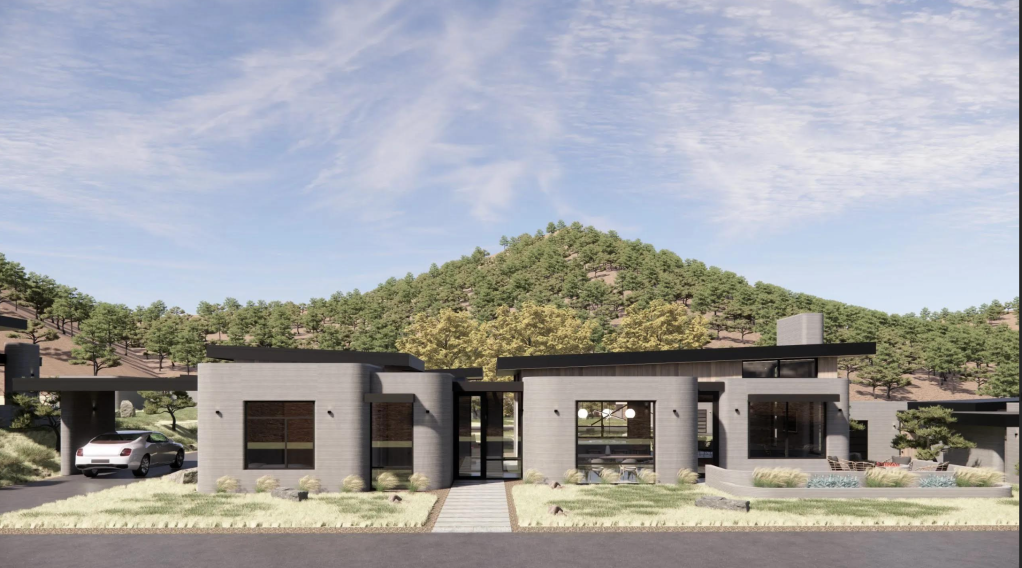
Now, the 55-acre property is set to become an experimental residential development with 106 3D-printed homes, which will make it one of the largest 3D-printed communities in the United States.
In that sense, the property represents a bridge between an early chapter in Salida’s history and an emerging future where new building methods could play a key role in expanding the nation’s housing supply.
Cleora at Salida East, where construction is now underway, has the makings of a transformational real estate project for the town of Salida. Beyond its local impact, the project could serve as a proving ground for emerging 3D-printing technology and its potential to alter how homes are built.
Fine-tuning the 3D-printed process
The developers behind Cleora identified the property as a strong site for a 3D-printed development because it offered the scale, environment and market conditions needed to test and refine the technology. For one, the project provides enough housing volume to improve efficiency over time and make the project more economically viable.
Additionally, Colorado’s challenging climate, mountainous terrain, labor constraints and high construction costs make Salida a good proof-of-concept setting for the technology.
Cleora Managing Partner Greg Kenny told HousingWire TBD that the team is still refining its construction process.
“This is a great project to focus on. We can hit a large volume of homes and get to a point where we can value engineer this as we go. Like I said, out of the gate, it’s not cheaper or faster. It takes some time. It’s a steep learning curve,” Kenny said.
Cleora partnered with RIC Robotics to integrate robotics into the construction process. The robotic printer acts like a large-scale construction worker, automatically placing layers of concrete to build wall systems on the job site, layer by layer. This process, in some respects, mirrors the way traditional construction workers stack masonry materials to form a building envelope.
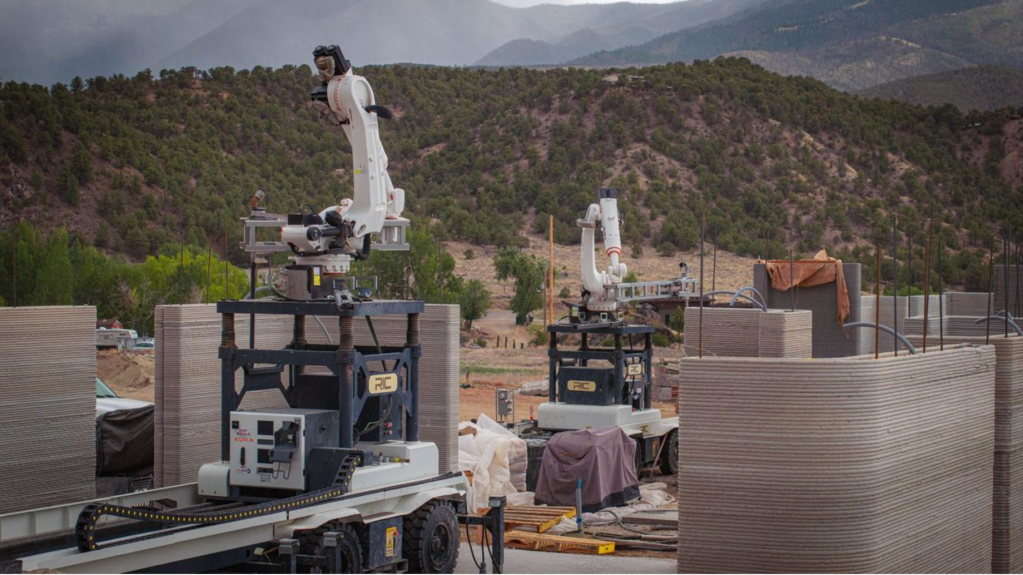
The robotics technology, which is intended to make the construction process more efficient, can be useful in areas where construction labor is scarce. However, Ziyou Xu, founder of RIC Robotics, stressed that robotics isn’t meant to make humans obsolete. In fact, Cleora has partnered with Colorado Mountain College to give students hands-on training in the construction process.
“We want to use robotics to subsidize labor, but this is not robots replacing labor,” Xu said. “The old generation is retiring. The new generation doesn’t want to use their hands to do manual labor anymore. They want to use the big robot, and now you can see teenagers on the job site operating the robot…that is the most fundamental change.”
The 3D-printed homes are designed to be more resilient than traditional wood-frame construction because their concrete walls offer greater resistance to wildfires, high winds, mold and severe weather. In an area like Salida, which is susceptible to wildfires, resiliency is key.
Robotic construction can help bring the cost of the 3D-printed concrete homes closer to the cost of conventional stick-built homes, but the Cleora team acknowledged that there are still improvements to be made before the process can scale. The cost of building is still higher, and the process isn’t quite up to speed, but the robotics and continued improvements have helped.
“As of right now, is it quicker? No, because we are still learning. But with that being said, we’re getting quicker every day and with every wall, quite frankly. At some point, I think it definitely will be quicker than stick-built. But we still want to make sure that the home is being built right,” said Jeff Post, another Managing Partner at Cleora.
The road to mainstreaming 3D-Printed homes
The hype for 3D-printed homes is real, but 3D-printed housing has yet to scale in any sort of meaningful way. Lennar partnered with ICON to deliver 100 3D-printed homes in Georgetown, TX, but the technology, by and large, has failed to break out into the mainstream.
Kenny believes that 3D-printed homes haven’t yet scaled extensively because there are still improvements that need to be made.
“Why hasn’t it been adopted? It is more cost-ineffective out of the gate because you’re ramping up a new skill set,” Kenny said. “We’re one of the first to do something of this magnitude, leveraging this innovation in a commercial way.”
Broader adoption will depend on proving the technology at scale through commercially viable developments. Construction speeds and costs will also need to improve through experience and value engineering before wider adoption.
Then, the robotics technology needs to become more widely accessible. RIC Robotics CEO Ryan Cox argued that one of the biggest barriers to widespread adoption of 3D-printed construction is the high cost and technical complexity of deploying robotic systems.
“One of the biggest obstacles that the industry’s had to overcome was the barrier to market entry in robotics. Previously, you were looking at millions of dollars in robotics mobilization and then a highly technical skill set,” Cox said. “The barrier to market entry in the beginning was just hard as heck to overcome.”
“Ric Robotics has kind of lowered that barrier by providing the opportunity to share equipment, the opportunity to share personnel, the opportunity to share knowledge, and not holding that in a capsule that you know you have to pay for, but instead giving it freely so we can expand not only the industry but our abilities within it,” Cox added.
Robotics innovation gains steam
The U.S. Department of Housing and Urban Development (HUD) recently opened applications for a program that would provide up to $10 million in funding to advance robotics and artificial intelligence in homebuilding. The goal of the program is to foster innovation and determine whether these technologies can accelerate construction, improve labor productivity, lower costs and ultimately increase housing supply.
While the funding is geared toward factory-built housing, HUD’s initiative reflects a growing interest in using robotics and automation to improve residential construction and potentially lower the cost of housing. Any advancements in robotics could potentially benefit 3D-printed housing by improving efficiency, reducing costs and helping the technology move closer to broader adoption.
HUD has also previously supported efforts to test 3D-printed housing. In 2023, the agency awarded a $600,000 grant to the city of Nome, Alaska, to fund a portable 3D printer that would evaluate the technology’s performance in extreme sub-Arctic conditions.
Whether or not HUD will provide future funding for 3D-printed homes is yet to be determined. However, the developers behind Cleora and RIC Robotics see their project as a crucial testing ground for the technology. As the industry looks for new ways to build faster and more cost-effectively, projects like Cleora may provide the real-world testing and refinement needed to move 3D-printed housing from experimentation to mainstream adoption.