
Exactly 50 years ago this time of year, a 51-year-old man handwrote a four-page letter on a legal pad to his then 21-year-old son, one of seven children – six of them sons and one angel of a daughter – who was spending a semester studying in Dublin, Ireland.
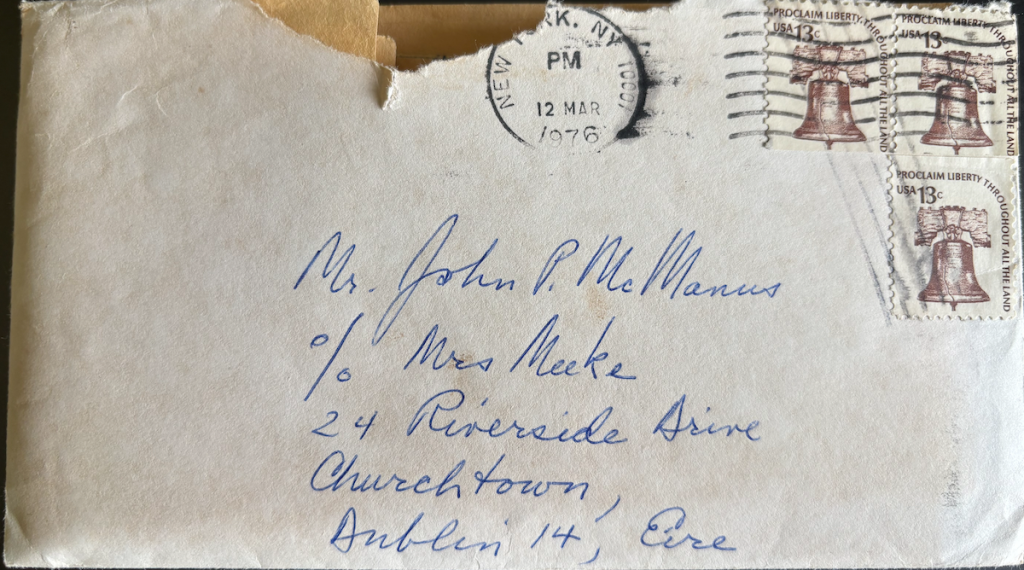
The letter’s narrative arc, now mostly a lost art, began by directly addressing the gift of the moment to both the writer and the receiver.
“… to be able to have such an experience at your age must be a terrific joy – also you are by nature extra appreciative of new sights and sounds, so I think of how lucky you are over and over again.”
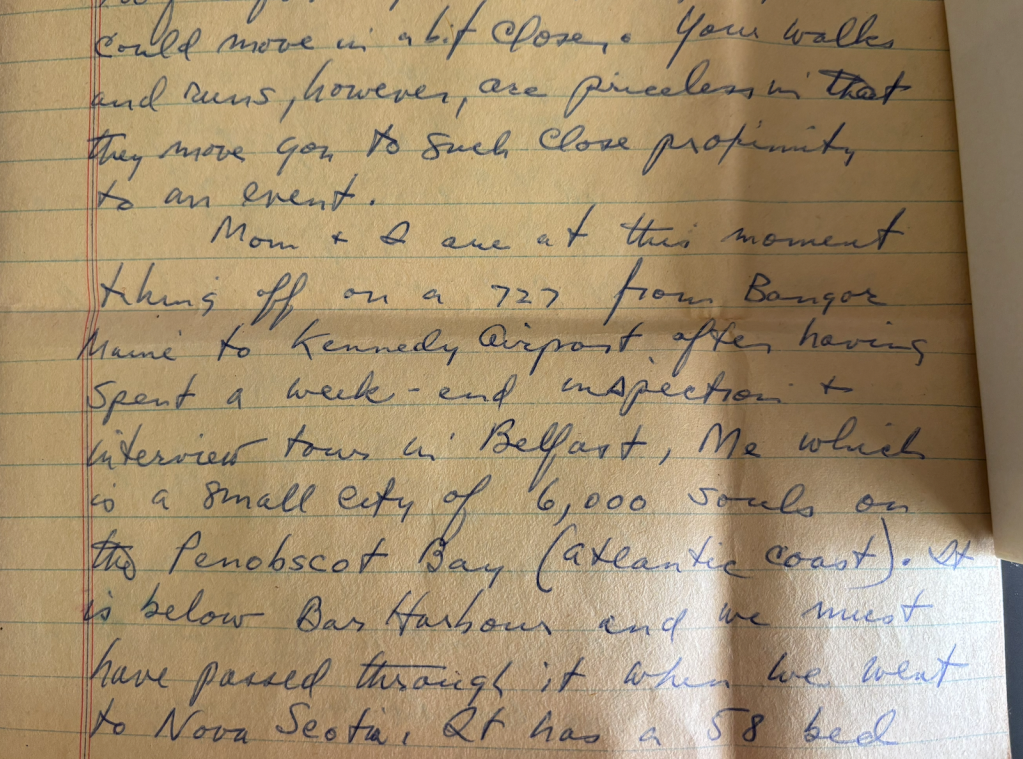
From such an introduction, the letter goes on to relate details of the writer’s professional, personal, and familial dilemma of the moment, a crisis, in fact, concerning the end of an illustrious medical career in New York City that would come to a sudden, humbling end amid the whirlwind of financial collapse then overtaking the city.
“I will definitely discontinue my total commitment to ….on July 1, and therefore must decide what to do shortly…”
What follows then is a brilliantly laconic briefing on each of the siblings, including the dog and cats. The 51-year-old man wrapped the letter in this bow:
“We miss you and should we decide on Belfast, Maine, we hope you will consider it … the University of Main catalogue will be sent for… Enclosed find check. Love, Dad”
Exactly 50 years later, what strikes me most about that letter isn’t the financial uncertainty. It isn’t the career crossroads. It isn’t even the understated generosity of the enclosed check.
It’s the voice. The literal workaday voice, woven plainly and inextricably together with the moral one.
Reading it now, I realize my father was writing from a place of responsibility that had little to do with rules, expectations, recognition, or reward. He was simply doing what he believed a father should do. He was reaching across an ocean to reassure a son, update him on the family, share a burden honestly, and remind him that he was loved.
Nobody required him to do that.
He didn’t have to write four pages by hand on a legal pad. He didn’t have to explain what he was facing professionally. He didn’t have to offer encouragement before discussing his own uncertainty.
But in another sense, he did. Something inside him compelled it.
Earlier this week, I found myself thinking about that distinction while reading yet another account of Japanese soccer fans remaining in stadiums after World Cup matches to collect trash and clean the stands before leaving.
The story has become familiar enough that it no longer surprises people. Yet it remains remarkable. Nobody asks them to do it. Nobody checks whether they do it. Nobody hands out prizes or recognition for it. They don’t have to. But somehow, they do. Or perhaps more accurately, they feel they must.
The action comes from an internal understanding that a place should be left better than it was found. That responsibility belongs to everyone. That certain things are simply the right thing to do.
Over the years, I’ve come to believe that this same quality runs through much of the homebuilding business community I’ve been privileged to know. Not all of it, certainly. No industry has a monopoly on virtue.
But I’ve encountered this trait often enough among builders, developers, trade partners, suppliers, lenders, and business leaders that it feels less like coincidence and more like a defining characteristic.
These are people who often show up before dawn and stay long after the workday is done. People who answer the phone because a customer is worried. People who quietly mentor younger colleagues. People who take responsibility for mistakes even when they could plausibly point elsewhere. People who continue showing up during the difficult seasons when markets turn, margins compress, interest rates rise, or projects go sideways.
Most of those actions never make headlines. They’re rarely celebrated, and rarely should be. In many cases, nobody even notices, and that’s the way it should be.
Yet they happen. Not because somebody wrote them into a job description. Not because a consultant advised them to do it. Not because a performance metric required it.
They happen because an internal voice says: This is your responsibility. These people count on you. This is what you do.
For many of us, that voice was first introduced by a father, a mother, a grandparent, a coach, a teacher, or a mentor. Sometimes it arrived through formal lessons. More often, it arrived through example.
A handwritten letter. A promise kept. A sacrifice made quietly. A willingness to do difficult things without seeking credit.
The homebuilding industry is, at its best, a business built on that inheritance. Homes themselves are physical expressions of responsibility. They represent shelter, security, stability, and possibility for families whose lives will unfold within those walls for years and decades to come.
That responsibility cannot be sustained by regulations alone, incentives alone, or even profit alone. It depends on people who feel accountable when nobody is watching.
People who don’t merely ask, “Do I have to?” People who ask, “How could I not?”
So this Father’s Day, I’m grateful for the fathers whose names appear on company letterhead and organizational charts. I’m equally grateful for those whose names never will. The ones who taught through example that responsibility is not primarily an external obligation.
It’s an internal calling. The shoulders we stand on are often those of people who simply kept doing what they believed was right, necessary, and honorable, whether anyone noticed or not.
Fifty years after receiving that letter, I’m still learning from one of them.
Happy Father’s Day.